
Tag: brand voice

How to Write Amenity Descriptions That Rank and Still Sound Like You

There’s a copy-and-paste bullet list living on roughly every apartment website in America, and it reads something like this: resort-style pool, state-of-the-art fitness center, wood-look flooring throughout. Maybe a gourmet kitchen if the budget allowed for quartz. You’ve read it a hundred times. So has every prospect comparing you to three other communities on their shortlist.

That’s the problem with amenity descriptions. The amenities are the same across the industry, and the words we use to describe them: also the same. Tour 10 communities in the same submarket and you’ll see the same pool, the same fixtures, the same fitness center, all described in the same handful of phrases that have lost any power to mean something. The list is required to explain what you have on-site—but it doesn’t do the work of marketing what you really offer.

So let’s talk about how to write amenity copy that earns its place twice over: findable by the search engines and AI tools doing the matching, and distinctive enough that a real person reading it can picture their actual life in your community, not other.

Resort-Style Pool, State-of-the-Art Fitness Center, Wood-Look Flooring

Try reading your amenities page outloud—and then read a competitor’s. If you simply swapped three lines of writing between the two pages, could you catch it?

For most communities, the answer is no, and that’s not a knock on the marketer who wrote it. These phrases became standard because they’re efficient. “Resort-style pool” tells you the pool is big and nicely landscaped without making you write a paragraph. “State-of-the-art fitness center” signals the equipment isn’t a sad treadmill from 2009. “Wood-look flooring” tells a prospect they get the warm look without the warping. The shorthand works as shorthand.

But it shouldn’t become a shortcut, and the whole description. A prospect reads “luxury apartments offering resort-style living and state-of-the-art amenities” and learns nothing, because that sentence—they’ve read it somewhere else already. It’s not descriptive… ‘cause it’s not original. The words are doing the opposite of their job. What should differentiate has suddenly camouflaged.

The Amenity List Still Has a Job to Do in Search

Before we throw the amenity list out entirely, remember: People search by amenity. Constantly. Keep it. But change it up.

Prospective residents aren’t typing your community name into Google, because they don’t know it yet. They’re typing “apartments with in-unit laundry near me” or asking their phone “two bedroom apartments with a dog park in Tempe.” The amenity is the search. According to the NMHC and Grace Hill Renter Preferences Survey, an in-unit washer and dryer sits at the very top of what renters want, with the overwhelming majority interested and a real monthly premium attached. That’s not a vibe. That’s a feature people will pay more to get and will search specifically to find.

Which means the exact words matter. If your page says “thoughtfully appointed laundry solutions” instead of “in-unit washer and dryer,” you’ve written something so fancy it will get skipped by the exact searcher who wanted it. The same goes for the AI answer engines now standing between renters and your website. When someone asks ChatGPT or Google’s AI Mode for “pet-friendly apartments with a gym in Charlotte,” those tools read across the web and build an answer from whatever your site says. Generic, vague, or overdressed copy gives them nothing concrete to grab. We made the larger case for this in our piece on SEO copywriting for apartments, and the apartment website specialists at Resi and Jonah Digital have been sounding the same alarm: a thin or fluffed-up page doesn’t get surfaced, it disappears.

So the amenity terms stay. The pet policy, the in-unit laundry, the parking, the square footage, the floor plan names, all of it written in the plain words people search and say aloud. 

A Feature Tells. A Benefit Is Why Anyone Cares.

This is where most amenity copy stalls out: it lists features and assumes the benefit is obvious. Sometimes it is. Mostly it isn’t, and the benefit gets leases signed.

A feature is a fact about the property. A waterfall island. A 24-hour fitness center. A rooftop dog run. A benefit is what that fact does for the person reading it. The waterfall island is where you’ll seat your in-laws at Thanksgiving instead of exiling two of them to the hallway. The 24-hour fitness center is the 6 a.m. workout you can finally do before the kids wake up, and the gym membership you stop paying for. The rooftop dog run is not having to take the elevator down and walk half a block in February every time the dog gives you that look.

Same amenities. Different interpretation. The feature gets you found. The benefit gets you leased. The best amenity descriptions name the feature in searchable language and then, in the very next breath, hand the reader the small specific moment that feature unlocks in their life. You don’t need to do it for all 40 amenities. You need to do it for the few that matter most to the resident you’re chasing, so start getting to know your ideal resident (IRP)!

The Spec Sheet Is Not the Brand

Now for the part the whole industry keeps skipping. A complete, accurate, searchable list of features is a spec sheet. It is necessary. It is also not a brand, and it will never make your community feel like anything other than a building with stuff in it.

Multifamily has been swimming in a sea of sameness for years. The buildings look alike, the finishes are converging, and now, with AI-generated copy popping up all over the place, it’s no surprise: the building descriptions sound alike, too. Same amenity lists, same neighborhood blurbs, same “luxury living redefined” headline. When the product is hard to tell apart, the words become your last stand. So, giving up on copy? You’ve just laid your cards on the table. Waved the white flag. Given in.

But: Branding. That’s what can slice through all that—your verbal identity (voice, positioning, how your community talks and what it stands for). Funnel your IRP research into your amenity descriptions, and you’ve got yourself a winner. A community for young downtown professionals and a 55-and-better community in the suburbs can have the identical pool. But NOT identical descriptions. One pool is where you’ll recover on a Sunday after a long week. The other is where the grandkids will beg to stay an extra hour. The amenity is a commodity. The story you tell about it is not.

What a Good Amenity Description Does

Strip it down and a strong amenity description is juggling a few things at once, (seemingly) effortlessly.

It keeps the searchable term intact, so the people and the machines looking for that amenity can find it. It leads with, or quickly lands on, the human payoff, so the reader feels something instead of scanning a checklist. It stays specific enough that it could only be describing your community, which is exactly what helps an AI tool tell you apart from the property next door when a renter asks it to compare. And it sounds like you, consistently, so that by the time someone has read three amenity descriptions they’ve started to get a feel for who this community is, the same way you start to get a read on a person a few minutes into a conversation.

What it doesn’t do is reach for the worn-out adjective when a real detail would do more work. “Spacious gourmet kitchen” asks the reader to take your word for it. “An island with enough counter space for two people to cook at once” shows them. Specificity is the most underused tool in amenity copy, and it happens to serve search and persuasion at the same time, because a concrete detail is both more memorable to a person and more citable to a machine.

Keep the Keyword Where It Counts, Then Let Loose

The fear I hear most often is reasonable: if I optimize my amenity copy, won’t I flatten my voice into the same beige paste as everyone else? Yes, if you optimize everything. So aim to optimize the spots that move the needle and leave the rest of the copy free.

Search engines and AI tools pay close attention to a few load-bearing places. The page title. The first hundred words or so. The subheadings. The alt text on your photos. Put your real amenity terms there, in plain language, and you’ve covered the part of the page the machines weigh most. They care less about whether your third paragraph cracks a joke or paints a picture. That paragraph is yours. So is most of the page.

This is also why over-stuffing amenity copy backfires now. Repeating “luxury apartments with luxury amenities in our luxury community” is skipped by humans and AI engines alike. It’s not clear or trustworthy, being stuffed like that. No ranking, no human reader. No wins. Use the amenity term where it counts, say it the way a person would say it, and let related language carry the rest, the neighborhood, the floor plan names, the small details only your community has.

And when a line is doing real emotional (branding) work, protect it. The keyword can go somewhere else. There’s rarely another spot for the sentence that makes someone feel something.

One Pool, Two Completely Different Stories

A quick illustration, same amenity, written for two different communities.

The generic version, the one everybody writes: “Take a dip in our resort-style pool, the perfect place to relax and unwind in a luxury setting.” Come on, that could be any property in the country! It leans on two phrases the industry has worn down to nothing and can’t give a person or a search engine a single thing to hold onto.

For a downtown community chasing young professionals: “A saltwater pool on the eighth-floor deck, with skyline views and enough loungers that you won’t be circling for one at 5 p.m. on a Saturday. The unofficial Sunday recovery zone.”
For a family-focused suburban community: “A zero-entry pool with a shallow end the little ones can stand in, shaded cabanas for the grown-ups, and a grill area built for the kind of Saturday that turns into six families and a lot of hot dogs.”

Same pool, pretty much. Both versions name the solid features a searcher and an AI tool can use. Both hand the reader a moment they can see themselves inside. And crucially, you could never swap them, because each one sounds like the community it belongs to. That’s the whole game.

Where to Start With Your Own List

You don’t need to rewrite all forty amenities this afternoon. Start with the handful that drive your leases, the ones your ideal resident cares about most, and run each through three quick checks. 

  • Does it use the plain word someone would search and say out loud, or did it get dressed up into something unsearchable?
  • Does it give the reader the benefit, the real moment in their life this unlocks, or does it just state the feature and hope? 
  • And does it sound like your community specifically, or like a template that forgot to fill in the name?

Get those three right on your highest-impact amenities and you’ll already be ahead of most of your comp set, who are still copying and pasting “resort-style pool” and wondering why the page isn’t converting.

The deeper work of your community’s voice (deciding what your community sounds like in the first place, to align every description) is its own project. And it’s the part that makes all the copywriting downstream easy. That’s the work we love at Zipcode Creative. If your amenity list reads like everyone else’s and you’d like it to sound like the only community worth touring, let’s talk about your project.

SEO Copywriting: How to Write Copy That Ranks and Converts

Most apartment websites get optimized so much that people who find them won’t want to read them.

“SEO copywriting” has now become a checklist. Get the city name into every other sentence. Repeat “luxury apartments in Austin” until it starts sounding like gibberish. Just add in a 1200-word neighborhood guide that no human’s actually read start-to-finish, and there ya go. The copy might rank. But the prospect bounces and everyone points fingers at The [rental] Market.

That approach is failing on both ends now. It doesn’t convert humans who land on the page, and it doesn’t win the machines either. Google has penalized keyword stuffing for years, AI answer engines skip copy that reads like it was written for a crawler, and even when a stuffed page does rank, most searches now end before anyone clicks it. The fortunate part: Fixing one problem fixes the other. SEO copywriting for apartments has circled back to something refreshingly simple: Write genuinely useful, interesting content, structured so machines can understand it too.

Old SEO Rules? Goodbye Leases.

For about a decade, the formula was stable. Pick a keyword, hit a density target, build some backlinks, watch the rankings climb. (Like magic!) Property marketing teams (and the agencies they hired) wrote for the algorithm first and the resident second, because the algorithm was the gatekeeper. If Google liked you, people found you. If people found you, some of them leased.

Search doesn’t really work like that anymore. The Pew Research Center tracked the actual browsing of 900 U.S. adults and found that when one of Google’s AI summaries sits at the top of the results, people click through to a real website only about 8 percent of the time, compared to 15 percent when there’s no summary. They click a link inside the summary itself just 1 percent of the time. Nearly six in ten people in the study ran into at least one of these AI summaries in a single month, and that share has only climbed since. Which means your page can rank beautifully and the searcher still gets the answer and moves on, never landing on it.

For an apartment community, that means the page you keyword-stuffed for “pet friendly apartments near downtown” might be doing its job (informing the searcher) without ever earning the visit. And when someone does click through, they are landing on copy that was written to satisfy a crawler, not to make them picture themselves living there. Higher intent visitor, weaker page. Winning at SEO but losing at leasing. Major bummer. 

What SEO Copywriting for Apartments Actually Means Now

SEO copywriting is the craft of writing copy that search engines can understand and that people actually want to read. Both halves matter. Drop the first half and you have a beautiful page nobody finds. Drop the second half and you have a found page nobody acts on.

For apartments specifically, the search landscape is unusually competitive and unusually local. Prospective residents are not searching in the abstract. They are typing things like “2 bedroom apartments with a yard in Charlotte” or asking their phone “what apartments near me allow large dogs.” Your on-page SEO has to speak that language without sounding like a robot reciting it back. You have to be able to weave normal search terms into copy so it still sounds like a place worth living, not a listing.

This is where multifamily marketers have a real advantage if they use it. You are not selling a widget. You are selling where someone will sleep, host friends, walk the dog at 6 a.m., and maybe even hide from their roommates. That is emotional, specific territory. Copy that leans into the specifics tends to both rank and convert. Copy that only says “modern amenities meet timeless elegance” does neither.

Meet GEO (The Reason AI Reads Your Copy Before Your Prospect Does)

There’s a newer layer most property teams haven’t adjusted for yet. SEO got a sibling, and its name is GEO.

GEO stands for Generative Engine Optimization. SEO is about ranking in traditional search results, the familiar list of blue links. GEO is about being the source an AI engine pulls from when it generates an answer. When someone asks ChatGPT, Google’s AI Mode, Perplexity, or Claude “what are the best family friendly apartment communities in Nocatee,” those tools read across the web, synthesize an answer, and sometimes cite their sources. GEO is writing in a way to ensure your community is the thing they cite, not the thing they skip.

Bain & Company has reported that a large majority of consumers now rely on these zero-click, AI-summarized answers at least part of the time, and that overall organic traffic is sliding as a result. So the question for apartment copy has to go beyond “will this rank?” You also must determine: “If AI summarizes this category for a renter, does my community make the cut, and is it described the way I want?”

This isn’t a fringe worry, and the multifamily-specific teams who live in search all day have been raising the flag. Resi, an apartment website and SEO platform, has been walking property marketers through this exact shift to GEO, and puts it plainly: being left out of an AI summary isn’t like ranking a little lower, it’s closer to vanishing from the results altogether. Jonah Digital also brings up that renters are already researching apartments through tools like ChatGPT and Gemini, and that those models read and relay whatever a property site tells them, so a thin or generic site never gets surfaced. When the firms focused on building apartment websites are all sounding the same alarm, clearly the ground has shifted.

The encouraging part: the things that make copy GEO-friendly are not exotic. AI engines favor content that answers questions directly, uses clear and consistent language, defines what it’s talking about, and reads as credible (not salesy!) In other words, AI rewards the same clarity a good leasing agent uses on a tour. Meaning, you’re probably already capable of GEO writing. Just stop burying the answer.

Why Keyword Stuffing Backfires Now

Old habits die hard. Keyword stuffing (repeating a target phrase as many times as possible regardless of how it reads) backfires now for three reasons.

Search engines got smart enough to recognize natural language and actually penalize obvious stuffing, so the tactic doesn’t even win the ranking it was chasing. AI engines tend to pass over copy that reads like it was written for a machine, because their whole job is to surface the clearest, most trustworthy answer. And the page visitor can feel the difference instantly. Nobody has ever read “our luxury apartments offer luxury living in a luxury community” and thought, “Yes, this is the one.” (For one thing, get a thesaurus!)

Don’t abandon keywords altogether. Instead, use them the way a person would say them. If your primary phrase is “apartments for rent in Tempe,” you might use it once in your page headline, once early in the body, and then let semantically related language carry the rest: the neighborhood name, nearby landmarks, the kind of resident who thrives there, the floor plan details people actually search. That related vocabulary (sometimes called LSI, for latent semantic indexing) signals depth to a search engine and gives a real reader something to hold onto. The apartment website specialists at 30 Lines describe the goal as topical authority: every signal on the page, the copy, the headings, the metadata, even the image alt text, should reinforce the same subject, without anyone resorting to stuffing. Do that and the page reads as genuinely about its topic, to a person and a crawler alike.

Writing for Humans and Machines at the Same Time

You don’t have to pick one! The overlap between “what a person finds compelling” and “what a search engine and an AI find credible” has gotten so large that you can mostly write for one and serve both.

A person remembers a specific, vivid detail. A search engine and an AI reward specific, factual content. So when you write “the kitchen has a waterfall island big enough to actually seat your in-laws at Thanksgiving” instead of “spacious gourmet kitchens,” you have given the human a picture and the machine a fact, in the same sentence. A person trusts copy that sounds confident and honest. AI engines take trustworthiness into account (as much as a robot can). So writing plainly and accurately, without overpromising, helps you in both arenas. A person scans before they read. Search engines and AI parse structure to understand a page. So: clear headings and direct answers help everyone.

Stop treating SEO as garnish. It’s a seasoning that, handled well, makes the copy better. Constraints do that. Ask any songwriter who has had to fit a great idea into a chorus.

The One Thing That Cuts Through the Sea of Sameness

Multifamily has been swimming in a sea of sameness for a long time. Walk through ten communities in the same submarket and you’ll see the same quartz countertops, the same matte black fixtures, the same resort-style pool, the same “luxury” clubhouse with the same shuffleboard table nobody uses. The physical product has been converging for years. Same amenities, same features, same finishes.

Now look at the words. For most of that time, apartment copy has been written for exactly one audience: the search engine. And lately, more and more of it is being generated by AI, often from the same handful of prompts feeding the same models. So the buildings already looked alike, and now the descriptions of them are starting to sound alike too. Same floor plan language, same amenity lists, same neighborhood blurbs, increasingly produced by the same tools.

Which raises the question every property marketer should be sitting with. If the building is the same, the finishes are the same, and now the words are the same, how does a community actually stand out, get noticed, and resonate with the resident it’s trying to reach?

The answer is brand. It’s the one thing a competitor across the street can’t quartz-countertop their way into copying. And brand isn’t a logo you slap on at lease-up. When it’s built right from the start, through real research and strategy, and developed thoroughly enough to include a verbal identity (your brand voice, your positioning, the specific way your community talks and what it stands for), you end up with the thing that makes all of this easy: the know-how to write copy that’s compelling, worth reading, and unmistakably yours. The voice work done upfront helps every sentence written after it be on brand. Period.

How to Keep Your Brand Voice and Still Get Found

This is the part marketers worry about most If you optimize too hard, every community starts sounding identical, which is the exact opposite of what branding is supposed to do. So how do you stay discoverable without flattening your voice into the same beige paste as every competitor in your submarket?

A few principles that hold up. Keep your keywords in the load-bearing places (page title, first hundred words or so, a subheading, the meta description) and let your personality run free everywhere else. Search engines care a lot about those anchor spots and care much less about whether your third paragraph cracks a joke. That paragraph is yours.

Decide what your community actually sounds like before you write a word of web copy, because voice is a brand decision, not a copywriting one. A community for young professionals downtown should not read like a 55-and-better community in the suburbs, even if both are technically “luxury.” When your voice is specific, your copy is automatically more distinctive. That’s precisely what helps you stand out in an AI-summarized result that is trying to tell communities apart.

And resist the urge to optimize the soul out of a sentence. If a phrase is doing real emotional work, do not break it just to wedge in a keyword. There is almost always another spot in the copy for the keyword. There is rarely another spot for the line that makes someone feel something.

The Structure That Helps You Get Found and Get Remembered

Structure is where SEO, GEO, and good writing all shake hands. A few moves do a disproportionate amount of work.

Lead with the answer. If your page is about pet policy, the first thing on it should clearly state the pet policy, in plain language, before you wax poetic about the on-site dog park. Both AI engines and impatient humans reward pages that answer the question up front.

Use real subheadings that match how people ask questions. “Do you allow large breeds?” is a better subheading than “Pet Amenities,” because it mirrors a search and gives the AI a clean question to answer with your content. Write in scannable paragraphs, not walls of text. Three to five sentences keeps a reader moving and keeps your page easy for a crawler to parse.

Be genuinely complete. Cover the related questions a prospect would naturally ask next, all in one place. A community page that answers parking, pets, lease terms, and the vibe of the neighborhood in clear sections will outperform four thin pages that each answer one thing badly. Completeness signals authority to a search engine, helpfulness to AI, and respect to a human who doesn’t want to dig.

There’s a newer reason completeness pays off. Google has started treating renting the way it treats banking and healthcare, as a “Your Money or Your Life” topic, since where someone lives affects their finances and their safety. According to the Resi team, that holds property websites to a higher bar for trust, transparency, and accuracy; building to that bar becomes its own advantage. They’ve found that properties leaning into real expertise and trust gain visibility, while competitors still relying on thin content see double-digit drops in search performance. Thorough, honest, specific pages pull ahead. Vague ones fade into the background.

A Quick Before and After

Before: “Welcome to luxury living redefined. Our modern apartments offer the perfect blend of comfort and convenience in a vibrant community setting designed for the way you live.”

That sentence could be any property in America. It uses a cliché the whole industry has worn out, says nothing specific, and gives neither a person nor a machine a single concrete thing to grab.

After: “These are one and two bedroom apartments a seven-minute walk from the Blue Line, with in-unit laundry, a rooftop dog run, and a parking garage you will actually appreciate in February. Built for people who want downtown access without the downtown parking nightmare.”

Same length. The second version names the floor plans (search-relevant), the transit access (high-intent local detail), the specific amenities (concrete and citable), and the kind of person it is for (voice and positioning). It is more findable and more persuasive, because specificity serves both at once.

Where to Start This Week

You do not need to rewrite your entire web presence by Friday. Pick your highest-traffic page, probably your floor plans page or your main community page, and run it through three quick questions. 

  • Does it answer the obvious question in the first few lines, or make people scroll for it?
  • Does it use the words real prospects type and say aloud, or industry filler? 
  • And does it still sound like your community, or like a template that forgot to fill in the name?

That is the whole balance. Findable, credible, and unmistakably on-brand. The teams that get there are going to keep showing up, in Google and in whatever AI hands a renter next, while everyone still stuffing keywords disappears into the scroll.

If you want a second set of eyes on copy that is trying to do all three jobs at once, that is squarely what we do at Zipcode Creative. We would love to help you sound like the only community worth touring.

The Anatomy of an Apartment Email That Gets 40%+ Open Rates

Your apartment community’s email just landed in 500 inboxes. Three hours later, 47 people opened it. That’s a 9.4% open rate—and it’s quietly killing your leasing pipeline.

Here’s what makes this frustrating: email still works. According to HubSpot’s research, the average open rate across industries hovers around 42-43%. Campaign Monitor found that segmented email campaigns see open rates 14.3% higher than non-segmented ones. The data makes it crystal-clear: email marketing remains one of the highest-ROI channels in property marketing.

So why are so many apartment emails collecting digital dust?

The answer usually isn’t the platform or the timing or even the offer. It’s the brand—or rather, the absence of it. When your emails look and sound like they could come from any apartment community in America, they get treated like every other apartment email: ignored.

Let’s break down how brand consistency, voice, and visual identity actually drive email performance.

The Problem with Most Apartment Emails

Most apartment emails fail before anyone reads a single word of body copy. They fail in the preview pane. In that split-second decision between “this might be worth my time” and “delete.”

But the deeper issue isn’t just weak subject lines or bad timing. It’s that most property marketing teams treat email as a separate channel with its own rules (or no rules)—disconnected from the brand they’ve built everywhere else.

Think about it: your website has a distinct personality. Your signage was carefully designed. Your leasing team was trained on how to talk about the community. But your emails? Assembled from generic templates, written by whoever had five minutes, and sent without a second thought about whether they sound like you.

The result: Brand fragmentation. A prospect who fell in love with your community’s personality on Instagram or during a tour gets an email that feels like it was written by a different company entirely. That disconnect erodes trust—and trust is what drives email opens. 

When your emails feel consistent with every other touchpoint, recipients learn to recognize (and anticipate) your messages. Recognition drives opens. Opens drive engagement. Engagement drives leases.

Why Brand Consistency Matters More Than You Think

Brand recognition isn’t just a nice-to-have in email marketing—it’s the foundation of performance.

Here’s what happens when someone sees your email in their inbox: In about two seconds, they decide whether to open it, ignore it, or delete it. That decision isn’t based on a careful evaluation of your subject line’s merits. It’s based on pattern recognition. Do I know this sender? Do I trust them? Has their content been worth my time before?

Consistent branding builds that pattern. When your sender name, visual style, and voice feel familiar, you’re not starting from zero with every send. You’re building on previous positive experiences.

Research from Lucidpress found that consistent brand presentation across all platforms can increase revenue by up to 23%. While that study looked at overall brand consistency, the principle applies directly to email: when recipients instantly recognize your community’s emails as yours, they’re more likely to engage.

This is why the most successful apartment communities approach email as a brand expression channel, not just a communication tool. Every email is an opportunity. Take that opportunity to reinforce who you are and why that matters to both your residents and prospects.

The Subject Line: Your Brand’s First Impression

Your subject line is the first (and sometimes only) chance your brand gets to make an impression. It should sound like you—not like every other apartment email in someone’s inbox.

Generic subject lines get generic results. “New Listings Available!” and “Don’t Miss Our Spring Special!” could come from literally any apartment community. They’re forgettable because they’re brandless.

Branded subject lines perform better because they’re distinctive. If your community’s personality is warm and welcoming, that should come through. If you’re urban and edgy, let that show. The goal isn’t to trick people into opening—it’s to signal that this email is worth their time because it comes from a community they already connect with.

Some principles that work across brand personalities:

Specificity beats vague. “Your tour at The Emery—next steps” outperforms “Thanks for visiting!” because it tells the recipient exactly what they’ll find inside. Specific subject lines also feel more personal and intentional.

Personality should show, not hide. If your brand voice uses humor, a subject line with a wink can outperform a straightforward one—for your audience. The key is alignment. A playful subject line from a playful brand feels authentic. The same line from a sophisticated, upscale brand feels off.

Consistency builds anticipation. When recipients learn that your emails deliver value in a recognizable voice, they start looking for them. That’s when open rates go from acceptable to exceptional.

Voice, Tone, and the Art of Sounding Like Yourself

This is where most apartment emails fall apart—and where brand-conscious communities pull ahead.

Your brand voice is how your community sounds when it speaks. It should be consistent whether someone’s reading your website, talking to your leasing team, or scanning your email. When that voice wobbles—professional on the website, robotic in emails, overly casual on social—prospects notice the inconsistency even if they can’t articulate it.

The best apartment emails read like they were written by a person your audience would want to hear from. Not a corporate announcement. Not a sales pitch. A voice that’s fully you.

But not every email has to be a creative writing exercise. Instead:

Your greeting should feel natural for your brand. “Hi Sarah” works for most communities. “Hey Sarah!” works for some. “Dear Ms. Johnson” works for others. There’s no universal right answer—greet the way YOUR BRAND would greet (casually or formally, etc.)

Your body copy should reflect your personality. A brand that’s warm and approachable shouldn’t suddenly sound formal and distant in email. A brand that’s sophisticated and refined shouldn’t try to be casual just because “that’s how email works.”

Your calls to action should match your overall tone. “Schedule a tour” is straightforward. “Come see for yourself” is warmer. “Let’s find your perfect floor plan” is collaborative. Each signals something different about who you are.

The goal is that someone who’s interacted with your brand anywhere else would read your email and think, Hm! I’ve heard that voice before!

Visual Brand Elements That Drive Recognition

Before anyone reads a word, they see your email. And what they see either reinforces your brand or confuses it.

Sender name and “from” address are the most overlooked brand elements in email. “The Emery Apartments” feels different from “Sarah at The Emery.” Both can work depending on your brand personality—but the choice should be intentional, not accidental. For prospect nurture sequences, a human name often outperforms a property name because it signals personal attention. For community-wide announcements, the property name may carry more authority.

Visual design should extend your brand identity. Your email template is an extension of your brand guidelines—same fonts, same colors, same design sensibility. When someone who’s seen your website opens your email, the visual language should feel immediately familiar.

Photography matters more than most teams realize. If your website features professional photography of your community, your emails should too. Stock photos—especially obvious ones—undermine the authenticity you’ve built elsewhere.

Preview text is often wasted. It’s the snippet that appears after your subject line in most email clients—40-90 characters of valuable brand real estate. Don’t let it default to “View this email in your browser.” Use it to extend your subject line’s personality and give readers another reason to open.

Keep your visuals consistent, down to the smallest details. If your brand uses a specific shade of blue, that blue should appear in your email headers. If your typography is clean and modern, your email fonts should follow suit. These details accumulate into recognition.

Timing, Frequency, and Staying Top of Mind (Without Being Annoying)

Brand consistency extends to how often you show up—and when.

Predictable timing reinforces brand trust. If you send a resident newsletter every first Thursday of the month, your residents learn to expect it. That expectation is a form of brand relationship. Random, sporadic sends feel less intentional and carry less weight.

For prospect communications, the rhythm matters too. A well-paced nurture sequence that delivers value at predictable intervals builds familiarity. A desperate flurry of emails during lease-up panic feels like exactly what it is—and damages the brand perception you’ve worked to build.

Over-communication is a brand problem, not just a tactical one. When you email too frequently, you’re not just annoying people—you’re training them to devalue your brand’s communications. Each email that gets ignored makes the next one easier to ignore.

The principle: only send emails worth opening. If you don’t have something valuable to say that’s aligned with your brand’s purpose, don’t hit send just to stay visible. Silence is better than noise when noise erodes trust.

Segment to stay relevant. One way brand consistency breaks down is when you send the same message to everyone regardless of their situation. A prospect who toured yesterday and someone who went quiet six months ago shouldn’t receive identical emails. Neither should someone looking for a studio and someone looking for a 3BR.

Segmented campaigns see dramatically higher engagement—Campaign Monitor puts it at 100% higher click-through rates—because they feel relevant. And relevance is really just brand consistency at the individual level: communicating in a way that shows you understand who someone is and what they care about.

Putting It All Together

Hitting open rates of 40% or more isn’t about finding one magic trick. It’s about treating email as what it really is: an extension of your brand, not a separate channel with different rules.

Brand recognition built through consistent visual identity means recipients see your name and immediately know what to expect.

Brand voice carried through subject lines and body copy means your emails sound like you—not like a boring, generic property management template.

Brand trust developed through valuable, well-timed content means recipients have learned that your emails are worth their attention.

Each element contributes a few percentage points. Combined, they’re the difference between emails that get ignored and emails that drive tours, applications, and leases.

The apartment communities seeing exceptional email performance aren’t doing anything wild or off-the-wall. They’re just applying the same thoughts (and rules!) around branding to email that they apply everywhere else—with consistency and intention.

And in a channel where most competitors are still sending brandless, template-driven content to unsegmented lists, that consistency becomes a genuine competitive advantage. 

Start sharpening your subject lines, people.


Building a brand that shows up consistently everywhere—including the inbox? That’s what Zipcode Creative does. Let’s talk about how your community’s brand can work harder in every channel.

Balancing Brand Voice and SEO Writing in Multifamily

Writing for Brand Voice vs. SEO

Marketing your multifamily community means you have to pay attention to your writing from every angle. It has to sell and convince—but first it has to be found. SEO gets your audience to your website (from those magical Google results). Brand voice captures them and convinces them.

Branding is the heart and soul of your brand. If you’re consistent and clear on what your brand is, it will allow your ideal residents and prospects to resonate with you as a brand. Brand recognition and brand loyalty is tied up in branding—and using brand voice for apartments ensures your words align with every other part of your brand.

In order to achieve both website traffic and conversions (along with brand loyalty) you’ll need to find a way to create truly effective content by balancing SEO and brand voice in your multifamily writing.

Understanding Brand Voice & Tone

BRAND VOICE

Brand voice is your brand, put into words. You relay your core, the foundations of your brand. It’s who you are, what you do, what you believe, what you value, and what you bring to the table. Your soul comes through with your mission, vision and values.

With your brand personality, you can infuse your brand voice with the right words—if you’re traditional, formal, and elegant, it’s unlikely that you’d use a fragment rather than a full sentence.


BRAND TONE

Brand tone is the way you say it. Your words will be different depending on whether you’re writing a blog post about an upcoming event or writing a letter, welcoming your newest resident. One will be longer, and one may be slightly more casual. You’d also shift your tone if you were responding to a review—an apologetic and straightforward tone would work better there.

Both of these sets of writing are vital to multifamily to be able to engage authentically with your residents and prospects and keep the branding experience consistent. Build trust, build engagement, build your “fan base,” and see more loyal residents.

The Role of SEO in Website Copy


SEO, or search engine optimization, is tailoring your online presence—usually your website—to show up for more people searching for you (or for keywords related to your business). If you want to be a competitor in a crowded market, or boost your marketing with your website, focusing on SEO should be part of your regular to-do list. Writing website copy with a focus on SEO can help put you in front of the clients you want most.

SUCCESSFUL SEO FOR MULTIFAMILY

If you want SEO to work well for your multifamily website, focus on the following:

  • Keyword research: Understand what terms you could reasonably rank for
  • Focused content: Write content around the keywords you want to rank for and shift your headings and subheadings to include those keywords
  • Use links—both internal and external—to help boost your visibility and helpfulness

Remember: The Google algorithm is always changing. But it’s most focused on helpfulness and accuracy. Whatever is relevant and authoritative will win out.

Differences Between Brand Voice and SEO Writing

BRAND VOICE VS. SEO WRITING

The approach to both is different. The style is different. The objectives are somewhat shared. One is more about branding (who you are) and the other is more about marketing (how you reach your audience). So essentially brand voice vs. SEO writing is a new version of branding vs. marketing. Both necessary, both good.

Brand voice writing…

  • Is approached with the goal of communicating an idea and is formed with the brand personality and audience at the forefront. 
  • Is more creative in style, and less information-based
  • seeks to portray the brand fully through words and connect with the reader


SEO writing

  • Is approached by taking content topics and keyword research to create content that will reach the audience through search
  • Style is informative, addressing one specific topic
  • Seeks to increase visibility through higher search ranking

Balancing SEO and brand voice is vital to reaching your audience and communicating your brand’s values. (You can’t connect with someone who can’t find your website.)

CHALLENGES

Balancing the two types of writing can be a challenge.

Weak brand voice.
If your brand voice isn’t strong enough, it can be totally overcome by SEO writing that’s technical and helpful, but doesn’t necessarily sound like you. Might even sound like a robot (*cough* AI *cough*) and if it’s boring, they’re not gonna keep reading.

Not knowing your audience.
If you don’t know your audience (and haven’t done your research) you’ll be writing to…exactly who? Everyone? Probably no one. By recognizing your audience, you can address their pain points and write content that actually applies to them. Do the research and make content they’ll connect with.

Low-quality content.

Again, write helpful content that’s infused with your brand voice—so it’s recognizable as your brand, and it’s helpful to your audience. If you’re just writing blog posts to fulfill a keyword, it shouldn’t be obvious. It should still be helpful. Start with pain points, then move to topics, then work on long-tail keywords. (Plus, low-quality content will get dinged by Google anyway.)

When to Prioritize Brand Voice or SEO

CONTENT FOR BRAND VOICE

Brand voice should be the priority when you’re working on copywriting. Think: ads (physical and digital) email newsletters (“Hey, it’s me again!”) and social media posts where you’re directly engaging with followers.

You can still maintain SEO-friendliness while focusing on brand voice. Keep your audience in mind—and be helpful with information that still sounds like your brand.

CONTENT FOR SEO

SEO is technical. Longer form content, like blogs and website copy (and especially landing pages) should focus on SEO. It allows for long-tail keywords to be used in context.


Likewise, you can still manage to communicate using your brand voice even while you have SEO-focused content. After you have the keywords where you want, go line by line and make sure everything you’ve written still communicates your brand’s personality through words.

When you write a first draft of anything, go through it with a focus on either one, but keep both in mind. You don’t want to alienate your customers with a landing page that doesn’t sound anything like your brand or an ad that isn’t particularly engaging. What we’re saying is…Both! Do both!

Balancing brand voice and SEO is no small feat. Most companies have a hard time doing either one. Look at your current strategies. See where your SEO is getting you. Start measuring your results after you develop an SEO strategy, as well as a strong brand identity, including brand voice. Make adjustments to your current copy and create a guide for your content going forward.

The digital market is always changing—and you’ll need to change with it. Be visible with SEO and connect with customers using your one and only brand voice.

Apartment Brand Design—Behind the Scenes

Apartment brand design is a perfect combination of creative magic and being meticulous. From research to concepts to construction, your careful apartment brand design will help your company inspire while it innovates. And, with any luck, you’ll have fun doing it.

Bring function, creativity and artistry to your apartment community through the precise steps of brand conceptualization.

In one creative call, we listened to our client tell the history of the company’s late founder—his family’s background, his passions, his sayings. As we asked more questions, each of these details that we helped draw out created a well of inspiration. Of course, before we landed on a name that referenced the founder’s family ties, which makes for great storytelling, we had to ensure the rest of the brand could keep up. We’ll show behind-the-scenes of every step, so you can see what this looks like in a real-life brand.

Research & Discovery

LET THE IRP INFORM IT

Without research, you’re walking blind. Without discovery, you’re taking chances. Do the work not just behind the scenes—but even deeper. Find out who you want to attract by determining your IRP, your ideal resident profile. When you can identify who you want to reach, and get to know “who” they really are, you can tailor your brand to attract and retain them!

What does this research look like? Look at geographics, demographics, psychographics, and behavior.

CREATE BRAND VOICE CONCEPT

How are you speaking to your IRP, and how do you engage with them? The research you did to find their psychographics and demographics will help you choose properly here, too. What problem is your apartment community solving? Why do you exist? What are your mission, vision, and values statements?

When you create your brand voice, you also get to pick out the brand personality to help flesh out your brand, making everything about your brand easier to explain. Styles, habits, goals, priorities, and values all come to light with the mission and the personality outlined.

1-Brand-Voice

Logo Concepts

Collaborating on apartment brand design is a careful dance. Working with client preferences and using our expertise, we came up with a variety of logos for their team to review. (We’ll get to the corresponding color palettes, lifestyle stock photography, and textures/patterns in a second.) We always have our favorite apartment brand logo design—but we know we won’t make the final decision!

2-Logo-Concept-1

This concept had a solid, signet ring appeal to it. Classy and classic.

2-Logo-Concept-2

This logo concept offered a softer touch, with a breezier angle.

2-Logo-Concept-3

This concept felt a bit like “conventional, with a twist.” It’s fun to color inside the lines for a time, go a little wild and come back to order. A touch of fun.

2-Logo-Concept-4

Situated in the city of Wheaton, the logomark called out the location while keeping the typography modern and stately.

2-Logo-Concept-5

This one says “expect much more from your apartments—and we’ll be ready.” Serious and stylish.

2-Logo-Concept-6

Light, simple, easy, and beautiful. A sans serif with sweet curves attracts those looking for ease of living.

Each of these logo concepts, paired with brand visuals and brand style concepts is created with a slightly different vibe.

This approach offers so much more than only a logo could. A logo cannot bring out a full color palette. A logo cannot give insight into the lifestyle that your apartment brand (and its) design offers.

Brand Visuals and Brand Style Concepts

Visually, brands have to make an impression. To accompany the logo concepts, our team put together beautiful stock photography, corresponding color palettes, and textures and patterns that work with the possible architecture, interior design, and typography details. Each concept works with the interior design—so the color palettes are a little bit similar. Additionally, every concept is created with the IRP in mind.

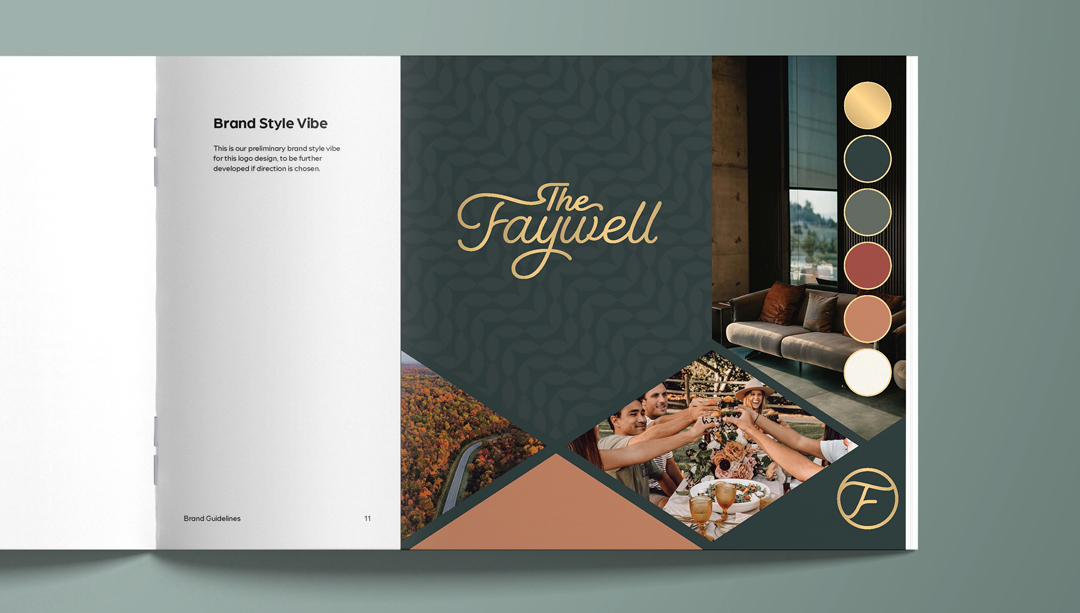
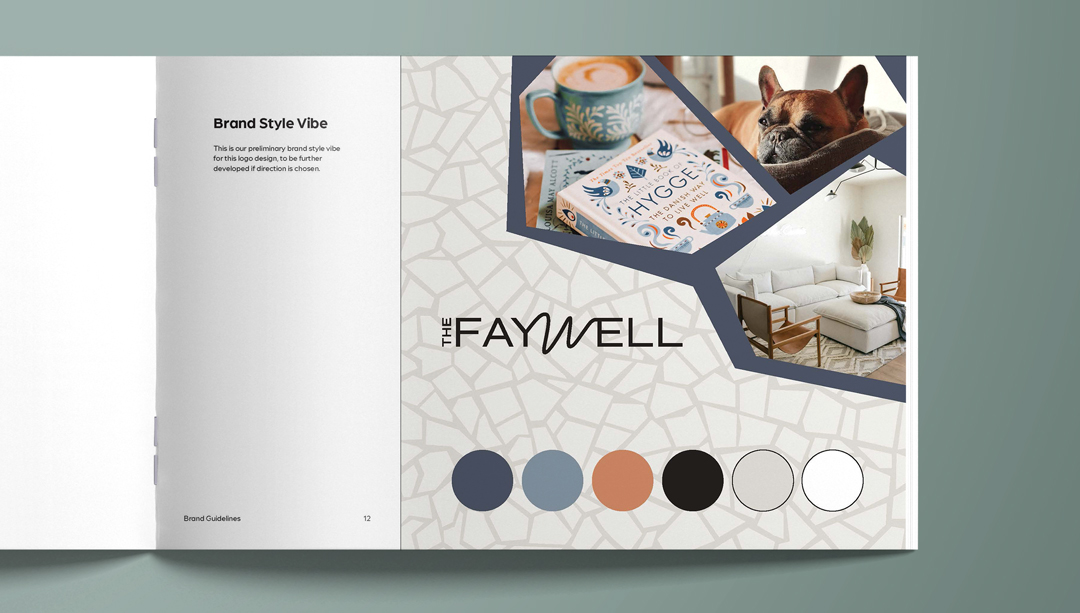
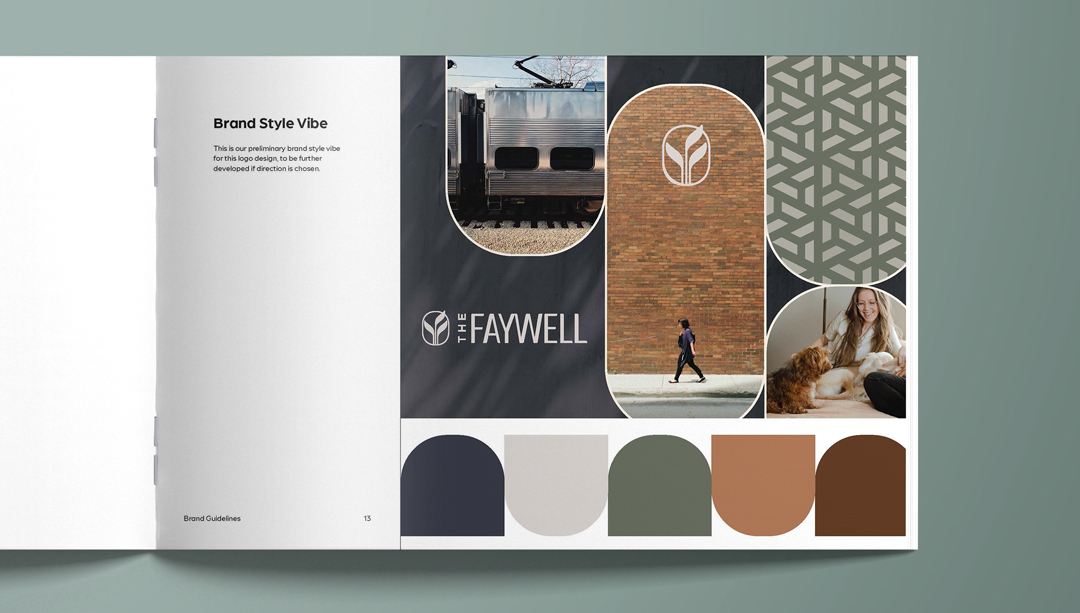
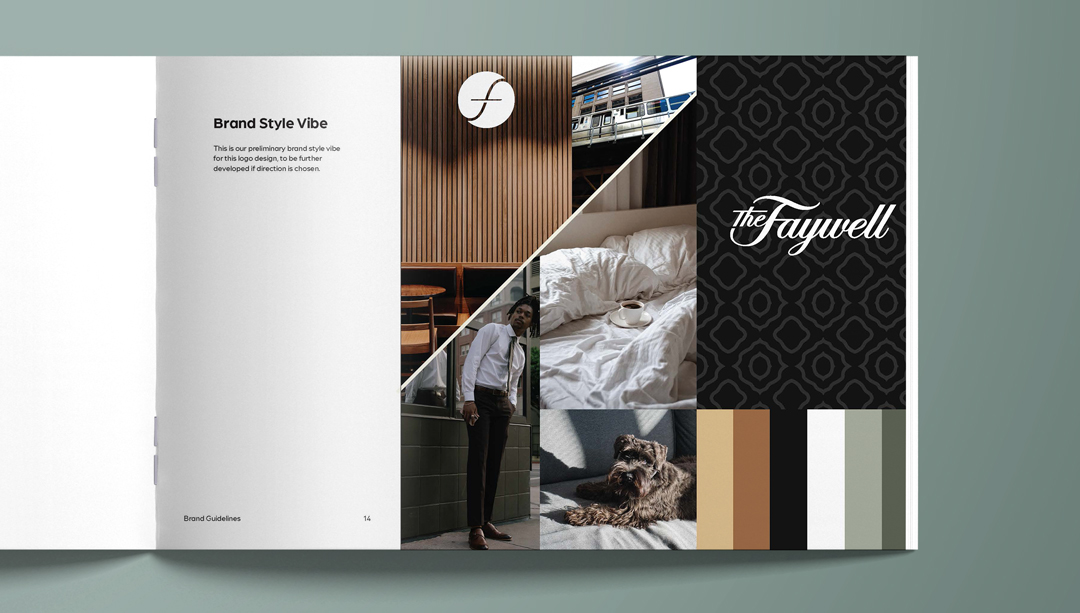
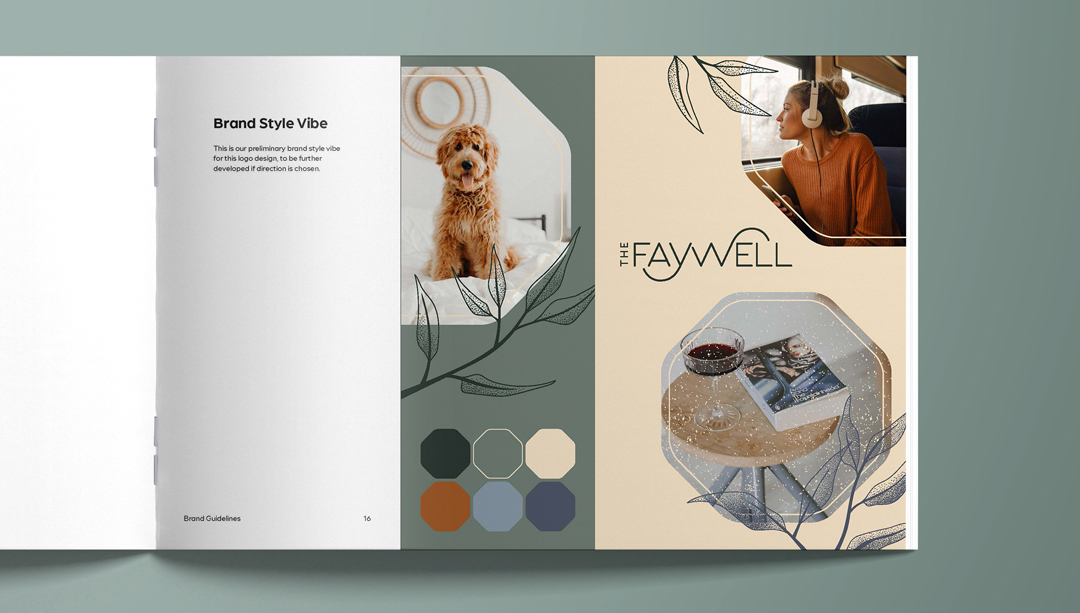
Each of the brand visual concepts that we created for the team at The Faywell was made to attract working professionals with discerning taste. With patterns and with photography, we further focused the vibe, whether eco-friendly, street chic, or totally hygge-homebody. See for yourself:

THE BRAND STYLE VIBES BREAKDOWN

3-Style-Concept-1

Concept 1

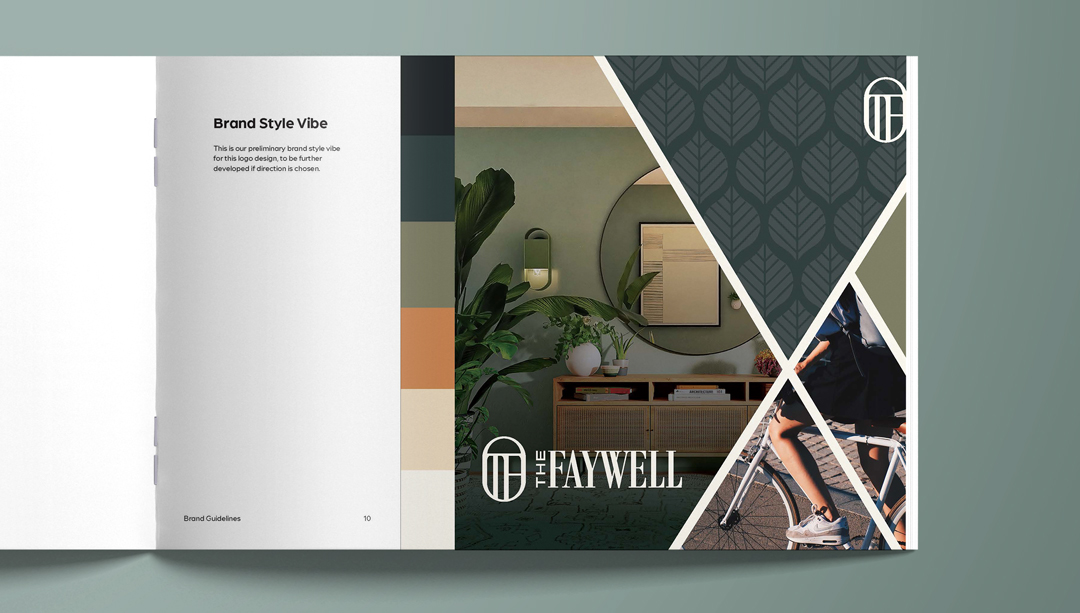
The leaves and the bicycle and the natural sage green featured in this concept tell the viewer: Embracing the calm of nature is still possible in the suburbs of Chicago.


IRP factor: Our IRP desired the calm of outer city limits while still staying stylish. 

3-Style-Concept-2

Concept 2

The rich tones of this brand style concept are focused on enjoying friends, going for scenic drives, and sinking into velvet sofas. The repeating pattern of subtle, soft, geometric leaves feels equally mesmerizing and soothing.

IRP factor: Suburbs for city dwellers can feel like social isolation—turning the focus to gathering and experiencing nature reframed the idea of getting out of town.

3-Style-Concept-3

Concept 3

Nothing to see here but cozy, creature comforts. With soft neutral tones, this warm concept is welcoming, cushy, and appealing in a Danish sort of way (pastry or country, you decide).

IRP factor: Our IRP is likely a city commuter. Home should be a haven for them.

3-Style-Concept-4

Concept 4

Welcoming city-smart commuters and appreciators of strong, sturdy patterns and structure, this concept is as sleek as it is sweet. Muted earthy tones along with shiny steel train cars offer a perfect balance between city and home.

IRP factor: Predictability should come standard for the resident who needs the train to run on time and wants an unfussy home, so we kept things strong and clean.

3-Style-Concept-5

Concept 5

Totally classic like a Fender hollow body electric guitar. White linens, wood walls, tailored pants all go together to create a scene that’s ideal for the keep-it-cool crowd.

IRP factor: Just because the IRP isn’t living in the city doesn’t mean they’ve lost all their street smarts. Creating a luxuriously beautiful.

3-Style-Concept-6

Concept 6

An easy going, enjoy-every-day vibe is happening here. Planning out your day with podcasts and enjoying a small glass of wine with your new pageturner, simple joys are the foundation in this take on The Faywell.

IRP factor: The hustle and bustle of the city isn’t for everyone, but having a predictable, reliable, and comfortable home is for this IRP.

Conversations Around Concepts

COLLABORATE AND CONVERSATE

After we presented each brand concept with the team at The Faywell, there were plenty more conversations to be had. Using the concepts, visual or verbal learners among the stakeholders (VP, marketing director, or owner) could easily process each concept and collaborate in conversation with us, the creative agency.

After you speak with the stakeholders, you can unite behind a singular concept when you determine which one will speak to your target resident while you represent your company (and its vision) clearly. The name, the logo, the photos, the color palette, the typography, it must all work harmoniously to give your prospects the most idealized version of your brand and your company’s priorities for their future residents.

THE POINT OF APARTMENT BRAND DESIGN CONCEPTS

Everything you’re investing time into now is meant to be a shortcut for you in your marketing, and to help you become a fully fledged apartment brand. When you start with the idea behind the vibe, the trajectory of the brand you’re building is a lot less bumpy. Branding involves a lot. Put in the work now to create a solid brand today and in the future.

We look forward to seeing how The Faywell continues in their brand journey.

What is Copywriting and Why Does Multifamily Need It?

Copywriting, Defined

What is copywriting? Copywriting is promotion, through words. These words can be persuasive or interesting, and they prompt the reader to use a business, a service, or an organization. Copywriters have to create text that can be adapted for any number of channels: print, radio, website. Copywriters also need to be able to adapt the copy (also sometimes called content) to different audiences.


BRAND VOICE VS. BRAND TONE


Brand voice is your brand’s personality, through words. It can be mature or youthful, jovial or serious, succinct or verbose, mysterious or open-book. Every way you would describe a person, can usually be used to describe a brand as well. Your brand attributes help create your brand’s unique voice.

Your brand tone is how you approach different scenarios. Similar to what we said above, the copy should be able to be adapted to meet the requirements of that particular time and place. A press release versus a brochure will have a different tone. But your brand voice will still be tucked in there.

Brand voice is WHAT you say.

Brand tone is HOW you say it.


COPYWRITING VS. COPYRIGHTING?

We do get this question. No, we’re not in the business of copyright law—and we never will be! You’ll have to find a law firm for that.

Copywriting means using words to promote a business.

Copyrighting means to register and mark an original piece of work as your own, with the © symbol.

We don’t do that last bit at Zipcode Creative. But we do plenty of copywriting for multifamily.

Copywriting-vs-Copyrighting

Using Copywriting For Multifamily

How can multifamily benefit from copywriting? First let’s look at how it’s used.

COMMUNITY/APARTMENT/ASSET NAMING

Naming multifamily assets is fun, and has long-term impacts on your brand. Hire a place that can do the research and guide the decision. It sets the tone for the rest of your brand, since it’s how people will refer to you—and can steer the direction of your logo and style.

BRAND GUIDELINES IN MESSAGING

Brand guidelines will get you places you’ve never been before. It’s a little like a superhero power card as if your brand were a person (or a Pokemon?)—but everyone at the company can see it. Once your brand voice (alongside your brand statements) is established using research and discovery and determining your ideal resident profile (IRP), you can go on to create some pretty sweet things like:

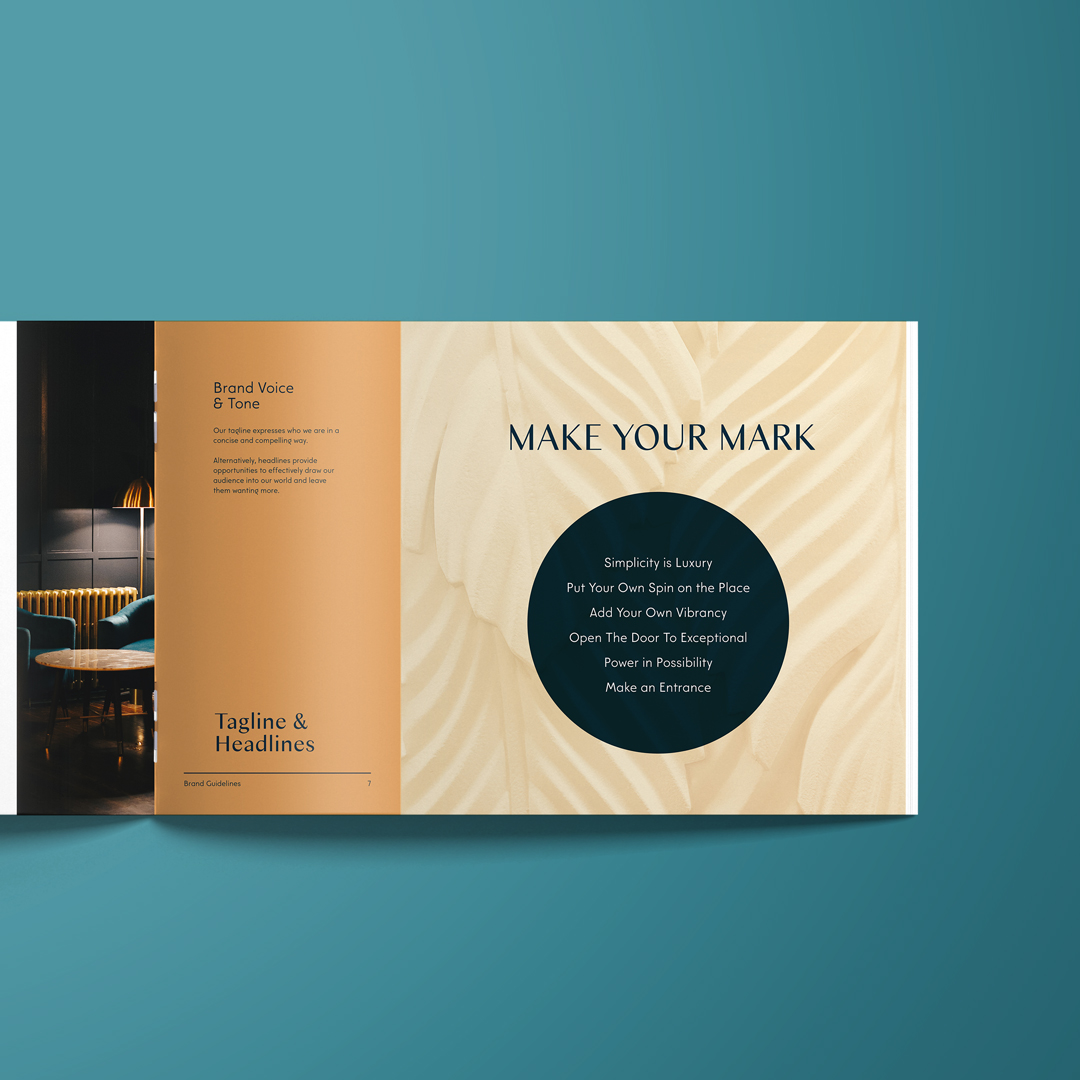
Brand Tagline – Like a slogan for your community—garner interest with your words summed up in one short phrase. 

Brand Headlines – More catchy things to say about the community that keep your prospects reading or scrolling.

Brand VocabularyNaming your amenities creatively or strategically can help create a sense of interest, intrigue, and brand loyalty among your residents. 

Each of these are part of the brand guidelines that we’ll create to keep your brand on track. Our copywriters take care of the verbal parts. Our designers take care of the visual parts. We put it all together to create a singular, beautiful guide to everything Your Brand. 

Also: Your taglines and headlines simply HAVE to grab attention. Sometimes that’s all anyone will ever read, of alllll the things you’ve written. Sad, but true. Make sure you’ve got a few of these up your sleeve: Tricks for Better Taglines and Headlines.


MULTIFAMILY COPYWRITING FOR EXTRA CREDIT

Hoping for a few bonus pieces of copy? There’s plenty more.

Website & Brochure Copy: Headlines, subheads, paragraphs, calls-to-action, it’s all copywriting. Make sure it’s good.

Campaign Copy: Whether it’s a moving campaign or pet-friendly campaign, ensure the words you’re using really sell the deal.

Email Copy: First your readers have to open the email—get them with a good subject line from your favorite copywriter.

Social Media Copy: Writing captions that fit in your brand voice is harder than it sounds.


CORPORATE COPY 

Mission / Vision / Values: Writing these clearly and having them out in the open—it’s more for internal purposes, but will help guide your client-facing brand. (It’s not easy, but that’s why we’re the professionals.)

Team Bios: Your experience and personal approach to property management should shine in your bio—and help you connect with the reader.

Client/Owner/Investor Messaging: We’ll make certain your message is geared to your client. Seal the deal whether seeking investors or presenting your management acumen to owners.

Taglines Headlines

Why is Copywriting Important for Communities?

Copywriting for community brands can = SUCCESS

Spell it with me: S-U-C-C-E-S-S. It has a nice little rhythm to it.

What do you most want from your efforts in your community? 

Success…which comes from signed leases. 

Which comes from prospects that turned into leads that turned into residents.
How do you get from prospects to residents? By connecting, showcasing, and converting.

Copywriting in multifamily communities is key to those three things.

CONNECT

Make an emotional connection by establishing your brand voice and telling a STORY.

SHOWCASE

Show what you have and how it’s the answer to their problems through clear and enticing communication.

CONVERT

Give them a reason to click the “Apply Now” button. You’ve gotten them this far, now convert leads with your brilliant copy (including amazing CTAs.)

When you have a resident—you want them to stay. A strong brand, which is BOLSTERED by excellent copywriting, will be able to maintain loyalty and retain residents—possibly even turning them into your own influencer-style, walking-word-of-mouth-ad brand advocates!

A Professional Copywriter vs. Your “Good Enough” Colleague

If we haven’t convinced you yet, now’s the moment. You’re considering having your colleague who’s “pretty good at writing” pen some copy. For your brochure, for your website, for your social. There are a few places where this could be…fine. Not great, but fine. Social media doesn’t require a huge amount of writing chops—but it could still impact your brand negatively if it’s not up to snuff.

If your colleague really is a good writer, great—use them. But also be aware that because “copywriter” isn’t likely their job position OR in their job description, they won’t be prioritizing the writing you’ve asked them to do (and all the research that has to go into it). Additionally, it’s not the best use of their (or of your) time and will take them longer than a pro.

A professional copywriter for multifamily, like the ones we have at Zipcode Creative offer three things that your “good enough” colleague may not:

EXPERIENCE

A professional copywriter is just that. They have processes that they’ve developed over years. They’re in the know with copywriting trends, as well as what is most likely needed for each job. 

Your “good enough” colleague will probably know your audience’s challenges and pain points, but those can easily be communicated to the copywriter as part of their research prior to writing.

EFFICACY

A pro copywriter for multifamily can create an emotional connection. They know what builds bridges, what entertains, and what kind of copywriting grabs attention. Keeping it short, tight, and compelling are all in a day’s work.

Your colleague of “decent writing chops” may end up writing too formally or casually, or worse: ignore your brand voice completely. All that work on the brand guidelines, for nothing!?

EFFICIENCY

A copywriter working professionally for apartment communities can easily follow your requirements. You’re the client, they’re the hired help. Pros also tend to know what needs to be done without being asked—even in a niche field like multifamily copywriting.

Your colleague—bless their heart—might not know the basic rules of copywriting, and therefore, waste time and money and energy on something that falls flat.

The best kind of copywriting for apartments tells a story, creates emotional connections, and helps build up the brand’s value. That sounds like a happily-ever-after to us.

Brand Vocabulary Defined for Apartment Communities

You probably notice that you use similar words and phrases often—you may even have some that are a bit of your signature style. Did you know that your apartment community should, too? When it comes to defining your apartment brand, try thinking beyond branding basics like vision, mission, and values. Once you’ve established those foundational brand pillars, it’s time to add a bit of personality and pizazz. That’s where your brand vocabulary comes in.

What is Brand Vocabulary?

A brand vocabulary is a set of select words or phrases used regularly in describing your community and in all of your copy. Creating defined brand language at the brand development phase helps you create a consistent and recognizable brand that looks and feels consistent across touchpoints. 

Why Do You Need Brand Vocabulary?

Your brand is more than just your logo or your signature colors. How you speak, the words you use, and your style are just as important—and recognizable—as your visual branding elements. 

Similar to how individuals favor different terms, phrases, and sentence structures, brands can leverage language to create a distinct and easily identifiable personality. Some of the world’s most successful brands, like Disney or Apple, use strong brand vocabularies to create immediate associations with their brand. 

When you hear the words, “magic,” or “kingdom,” for example, Disney is one of the first brands that comes to mind—and especially when the words are paired together. Apple has also developed its own style. When you see a word that starts with a lowercase “i,”  like “iHome,” most people instantly recognize it as part of the Apple ecosystem. The brand has expanded this format, using it not only across product names but also incorporating it into advertising to create a thriving and distinct brand vocabulary.  

When done properly, your brand vocabulary will also begin to build an association between particular words and your community. Over time, this helps to generate heightened brand awareness and recognition, while also allowing you to differentiate yourself from your competitors.

brand vocabulary

How to Create Brand Vocabulary

Once you understand what a brand vocabulary is and why it’s important for your community, it’s time to start developing your own. Just keep these tips in mind to ensure your vocabulary is as effective as possible. 

Keep it simple

When you’re developing your brand’s vernacular, don’t overthink it. Some words and phrases that you use often are naturally tied to your community and your industry. For example, apartment communities often use some variation of:

  • Studio
  • 1-bedroom
  • 2-bedroom
  • Amenity spaces
  • Lease
  • Resident

To set yourself apart from your competitors, it’s important to expand your vocabulary beyond industry terms. Look to your brand’s vision, mission, and values to determine other words that might be a good fit. For example, if your brand is more forward-thinking or modern, utilize words with that same feeling and tone. If you’re more traditional and classic, lean toward words that evoke that same feeling. You can also try thinking up creative ways to phrase typical industry-standard words for a more creative spin.

Make it unique

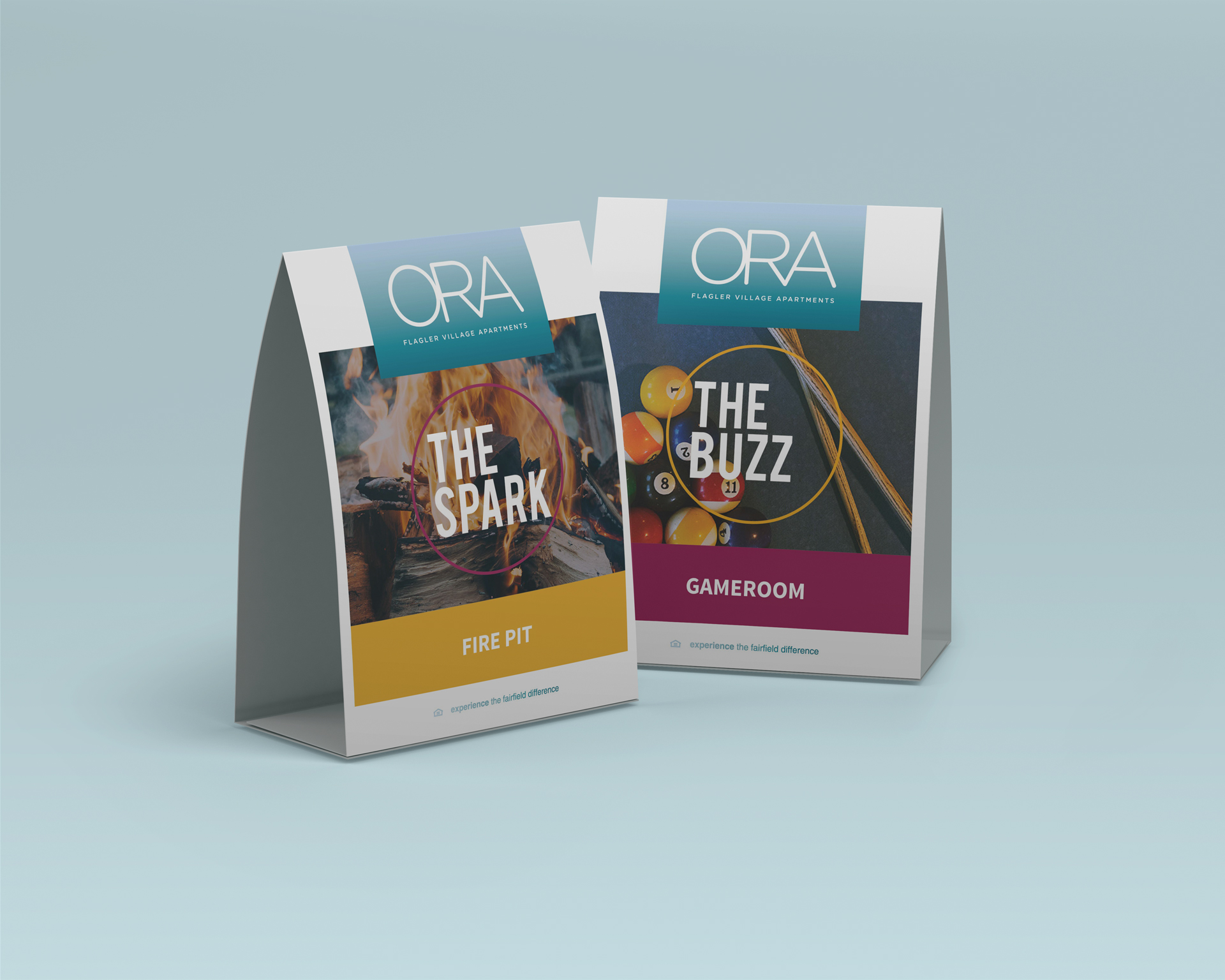
Using unique words or phrases to describe common amenity spaces can help you create intrigue and be more memorable. For example, instead of calling it an on-site dog park, opt instead for “The Bark.” Instead of calling it the business center or resident lounge, you can opt for something punchier and more modern, like “The Hive.” Thinking outside the box helps you develop more memorable names that help to create a strong community culture and make your spaces stand out more to prospective residents.

Stay consistent

Above all, staying consistent with your brand vocabulary is key. Once you’ve developed and defined the different words and phrases you’ll use, be sure that everyone is aligned. If you decide that you always want to call them “residents,” for example, it’s important that marketing materials never use the word “renter” or “tenant.” Similarly, your leasing staff or resident-facing teams like maintenance or the concierge should always call prospects “residents,” on tours or during other interactions. Creating a consistent vocabulary across touchpoints is what will help set you apart from your competitors.

Developing a brand vocabulary from scratch can be tough. If you’re struggling to find words and phrases that feel right for your community, it might be time to enlist the experts. At zipcode creative, we have a team of seasoned marketing professionals that can help you nail down the exact right terms to add to your repertoire to help your community stand out. Book a consultation with one of our experts today to get started!

ORA is ©Fairfield Residential  |  Work executed by Stacey Feeney, owner of zipcode creative, while under creative direction and employment at Fairfield Residential.

Brand Statements That Define an Apartment Community

When you work with a creative agency to develop your brand style guidelines, you may be expecting them to create your visual branding components like your logo and brand colors. But what is often overlooked in brand guidelines are elements like tone of voice and messaging. Brand statements, however, are crucial to developing a well-rounded brand and allowing you to create compelling and consistent materials that will help attract your target audience.

Multiple different brand statements work together to create your brand’s “vocal” identity and brand messaging. Each serves an important purpose that helps define who you are as a brand and an apartment community. Learn more about each brand statement and why you need them in your community’s toolkit.

Purpose Statement

To create your brand purpose statement, you have to find your “why” and identify why it is you do what you do. Your purpose should be greater than the obvious motivators like providing housing or making money. Instead, you should look to your greater purpose that is rooted in your beliefs and morals.

A great way to identify your purpose statement is to think about your community’s founding story. Was your community created to offer a unique living experience for residents? Was it created to fill a hole in your area’s housing market? Narrowing in on the answers to these questions can help you synthesize the “why” behind your community’s purpose.

Vision Statement

In a nutshell, your vision statement is the goal you are working towards. While your purpose statement explains your “why,” or your motivation, your vision statement summarizes your ultimate goal. Your vision statement should sum up your desired community impact. 

These high-level statements are often lofty and bold, and they speak to how the future you envision not only for your community but also for the world. It also should speak to the future you want to achieve over the lifespan of owning and managing your assets.

Mission Statement

Unlike purpose and vision statements, mission statements are focused on your actions. They focus on the more immediate future, and the daily actions you can take to help you work towards your loftier goals. 

Mission statements usually follow a loose format, which includes explaining your business and tying it directly to your company values. It should also focus on how you serve your prospective residents. When crafting your mission statement, be sure to hit on these three key components: purpose, values, and goals.

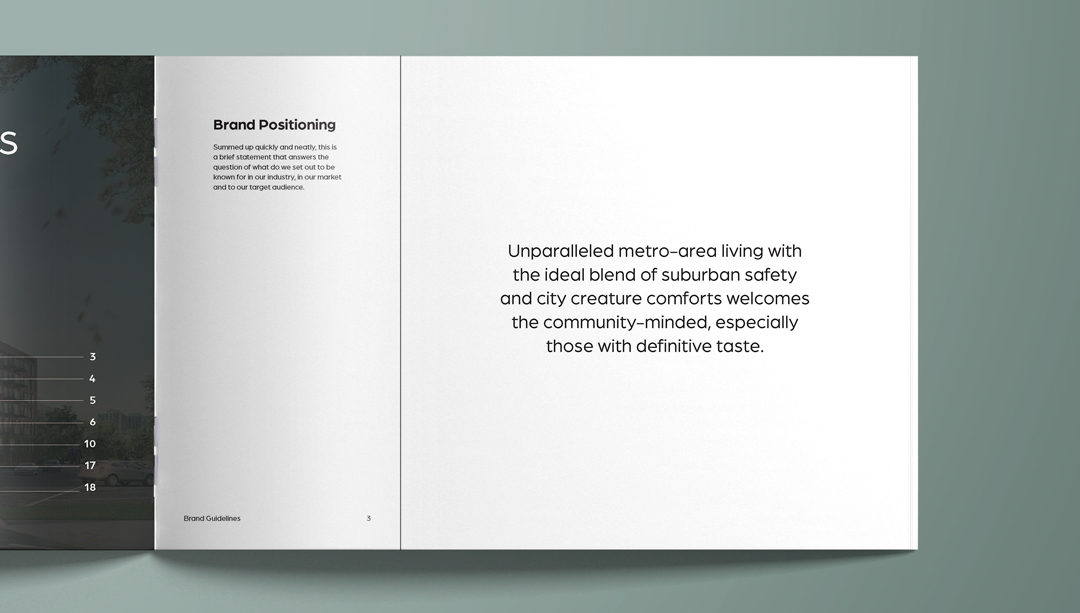
Brand Positioning Statement

Brand positioning statements help you craft customer communications. Once you have your vision, mission, and value propositions, you can blend them together to create your positioning statement. 

This statement should identify what your company does, the target audience, and your key differentiators. They often follow a similar structure:

(Company Name) is a (industry definition) for (target audience) that (unique value proposition).

Following this general format will help you create the first draft of your positioning statement that you can tweak and refine until it feels true to your community.

Brand Attributes

Once you’ve nailed down your vision, mission, and positioning statement, it’s time to give your brand a defined personality. Defining your brand attributes will help you start to define your brand’s tone and style, which allows your audience to get a better feel for your community. 

Brand attributes are words that describe your brand’s personality. They’re also typically paired with a short phrase or sentence to give added context and clarity. A few common brand attributes include:

  • Friendly
  • Authoritative
  • Witty
  • Bold
  • Energetic
  • Laid-back
  • Sophisticated
  • Trustworthy
  • Aspirational

Consider choosing between three and five attributes that you feel best represent your brand and stick with them to create a consistent style.

Value Propositions

Your community’s value propositions are what make them different from your competitors—they clearly define why a prospective resident would want to choose your community over another. Crafting value propositions is pivotal to creating strong marketing materials; they allow you to clearly articulate what makes your community one-of-a-kind, and in turn, help convert prospects into residents. 

Brand Identity Statement

Your brand identity statement is often a short, two or three paragraphs that describes your brand voice, tone, and style. This helps you expand upon your brand attributes and personify your brand even further. For example, your brand may sound like a friend spending their free time hanging with the resident. It could also be a sophisticated, elevated tone that alludes to a luxury lifestyle. Deciding on your overarching identity is pivotal to bringing your brand to life in a more practical way. 

Each of these brand statements works together to tell the whole story of your apartment community or property management company. Individually, they don’t tell the entire story—but when you use them all together, it helps you define who you are and create a consistent message across all of your marketing materials. Brand development plays a crucial role in setting you apart from your competitors and fostering easy brand recognition, which in turn results in a strong, stable community! 


If you need help crafting your brand statements, enlisting the help of a seasoned agency like zipcode creative can help you build the strong foundation you need. Reach out to our team today to get started!