



The Maverick: A Cinematic Take on Luxury Apartment Branding in a Saturated Market
Stacey Feeney
Sometimes the name is already on the page when we get the call.
That’s where this one started. Thompson Thrift came to us with a Class-A+ (yes, some folks call it luxury, we prefer other words) lease-up in Monument, Colorado, and a name they’d already landed on through their own internal naming process: The Maverick. They were excited about it and committed to it. They also came with what we now affectionately call The List — a tidy, polite, yet very firm rundown of everything the name was not supposed to evoke. No Webster’s dictionary definitions. No Old West vibes. No horses, no spurs, no rugged-frontier anything. And please, for the love, no Top Gun.
So our job was to take a name a developer had intentionally picked and land to honor that intention—without falling into the obvious clichés. (Harder than it sounds when the name in question might be one of the most culturally loaded words in American English.)
Here’s how we got there, and why the most interesting part of the project, again, wasn’t the logo.
The “What It Can’t Mean” List
Most naming projects start with a blank page. This one started with a name a developer was committed to, plus a clear list of “nopes” about what that name was and wasn’t supposed to mean. Different creative problem entirely. Less ideation, more interpretation. We had to ask “what does this need to mean” rather than “what should this be called”—since the latter was already covered by the developer.
That’s harder than it sounds. Names have associations, whether you want them or not. Say “Maverick” out loud and most Americans land in one of two places: a horse in a desert, or Tom Cruise in aviators. Neither was useful here. (And another property in Indiana already owns the modern-aviation interpretation, so even if we’d wanted to play that hand, we couldn’t.)
Which meant we had to ask another question: What version of “Maverick” do we want to channel?
The Vibe Wasn’t Western
The questionnaire is where this got fun.
We always ask developers to give us a personality read on the property. Celebrities, drinks, weekend activities, wardrobe, a car if they had to drive one. The references that came back from Thompson Thrift were pretty sweet and a bit unexpected.
Robert Redford. John Varvatos. Brooks Brothers. Whiskey neat. A Restomod International Scout. Jazz and yacht rock. A cigar by the campfire after an elegant dinner.
Read that list again. None of it is rugged cowboy. None of it is hotshot pilot. It’s all classic American gentleman. The guy who’s done well, knows what he likes, and has stopped explaining himself. Sophisticated, lived-in, not trying too hard.
That was the key. Maverick didn’t need to mean cowboy or pilot. It could mean independent enough to make his own taste. Which is a very different kind of person. (And, importantly, a much harder person to find a good apartment for in a market full of identical garden-style construction.)
When the Interiors Write the Brief
The other thing Thompson Thrift handed us early was the interior design direction. Honestly, that document did half the brand work before we’d opened a sketchbook.
The mood was Modern Glam. Moody charcoals. Brass accents. Dark wood. Marble surfaces. Dramatic lighting. Slatted wood detailing. Cigar lounge meets whiskey bar meets golf-clubhouse-after-hours and you’re pretty much in the right neighborhood.
This is the kind of brief that (if you’re paying attention) basically tells you what the brand needs to be. The interiors weren’t going to be rugged or aviation-themed. No, they were going to be elegant, confident, and a touch moody. So the brand had to match that energy or the whole thing would feel like a costume.
To that end, we treated the interior mood board as a creative brief alongside the questionnaire. Two source documents pulling toward the same place meant we could stop guessing and start crafting.
Meet Sam 4.0
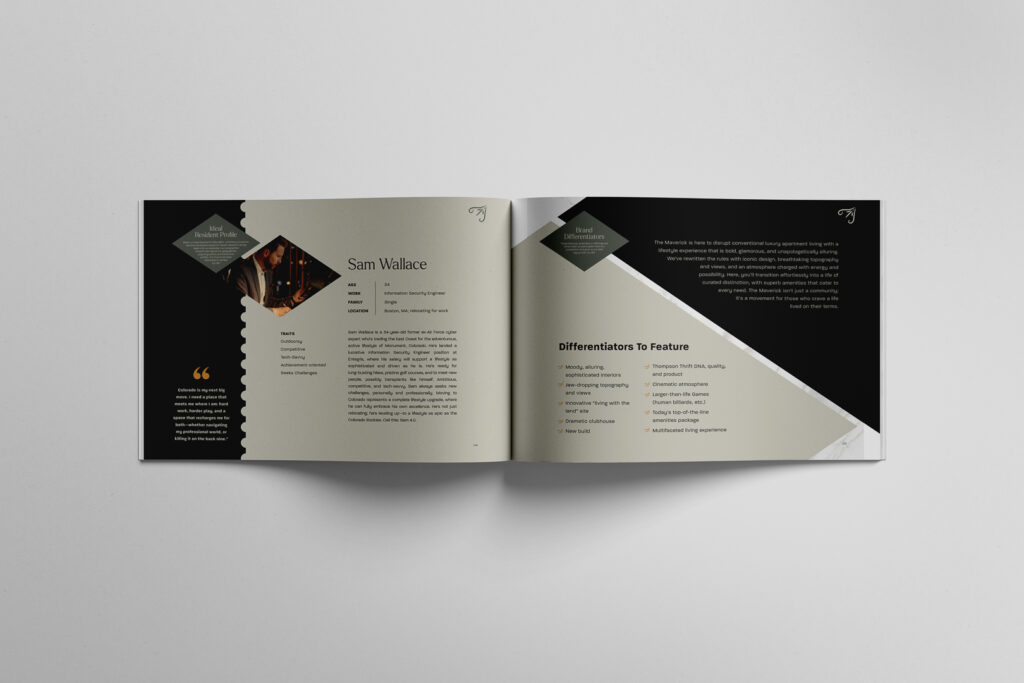
Every brand we build gets an Ideal Resident Profile. Not a summary of demographics, but an actual, named archetype with a job, a backstory, and a reason they’d choose this property over the three identical ones down the road.
For The Maverick, we landed on Sam Wallace. Thirty-four. Ex-Air Force cyber expert. Relocating from Boston for a tech job. Treating Colorado as a complete lifestyle upgrade — what we started calling Sam 4.0. (Versions one through three were all fine. This is the one where everything clicks.)
Sam has the income to buy a house and is choosing to rent for the flexibility. He’s brand-conscious without being flashy. He’s wellness-focused. He’s outdoorsy in a “I have nice gear and use it” way, not a “I sleep in a tent” way. Plus the most vital part: He wants his address to feel commensurate with the salary he’s earning.
Once Sam existed, every subsequent decision had a filter. Would Sam respond to this color palette? Would Sam read this headline without rolling his eyes? Would Sam tell his friends about this place, or would he sound embarrassed? Brand decisions get easier because they stop being subjective debates.
The Colorado Color Problem (And How We Dodged It)
Here’s a thing about branding apartments in Colorado: everyone defaults to the same palette.
It’s fine. It’s also why every Colorado property looks like every other Colorado property.
Thompson Thrift specifically flagged this as something they wanted to avoid. They didn’t want The Maverick to blend into the landscape. They also didn’t want generic earth tones that signal “we live here too” without saying anything more interesting than that.
Modern Glam gave us the third path: black, beige, brass-gold, and a deeper, grayer sage.
The sage is doing real work — it nods to place without falling into the cliché. Paired with black and brass-gold, it reads as moody and elegant, not landscape-blending. The beige softens the system and mirrors the wood-and-stone vocabulary of the interiors.
The result is a Colorado property that doesn’t look like a Colorado property. (On purpose.) It looks like a property that happens to be in Colorado — a difference that matters a lot when your IRP is choosing the address as a lifestyle statement, not a regional default.
Cary Grant or Beth Dutton? Equally Suited.
Once the strategic frame was clear, the creative direction wrote itself: classic Hollywood meets Modern Glam. Cinematic. Sophisticated. A little aware of its own coolness, in the most charming way possible.
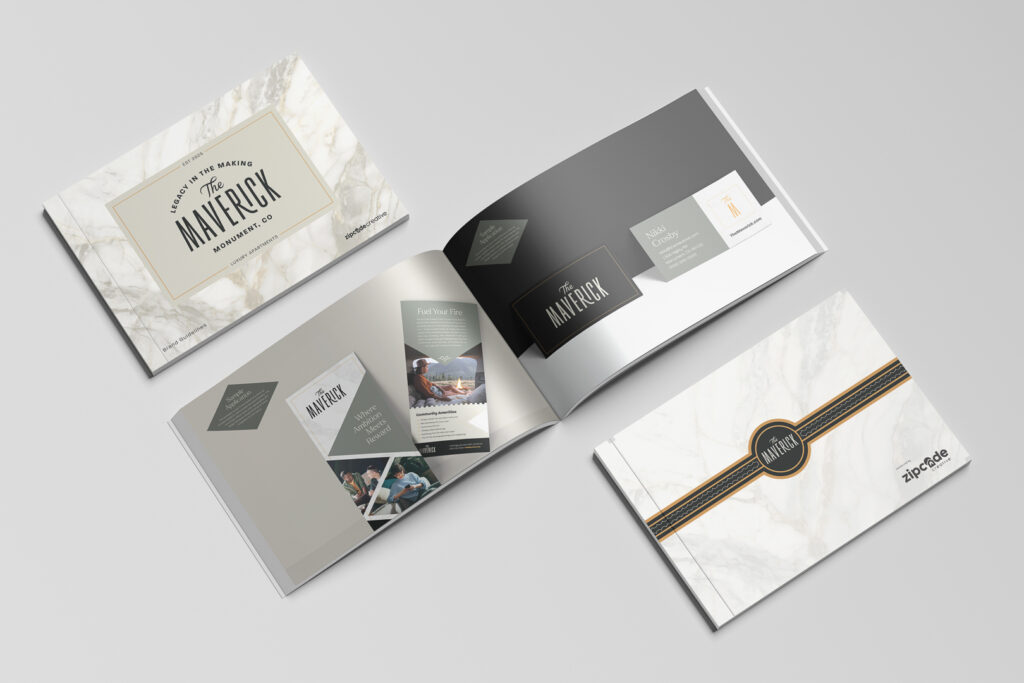
The wordmark uses a tall, elegantly condensed serif with a script The sitting above. The condensed proportions feel architectural — almost theater-marquee. The script adds intimacy and a little bit of swagger. There’s a small inverted i in the middle of MAVERICK that’s the entire personality of the brand in one design move — confident, subversive, slightly winking, but never loud about it.
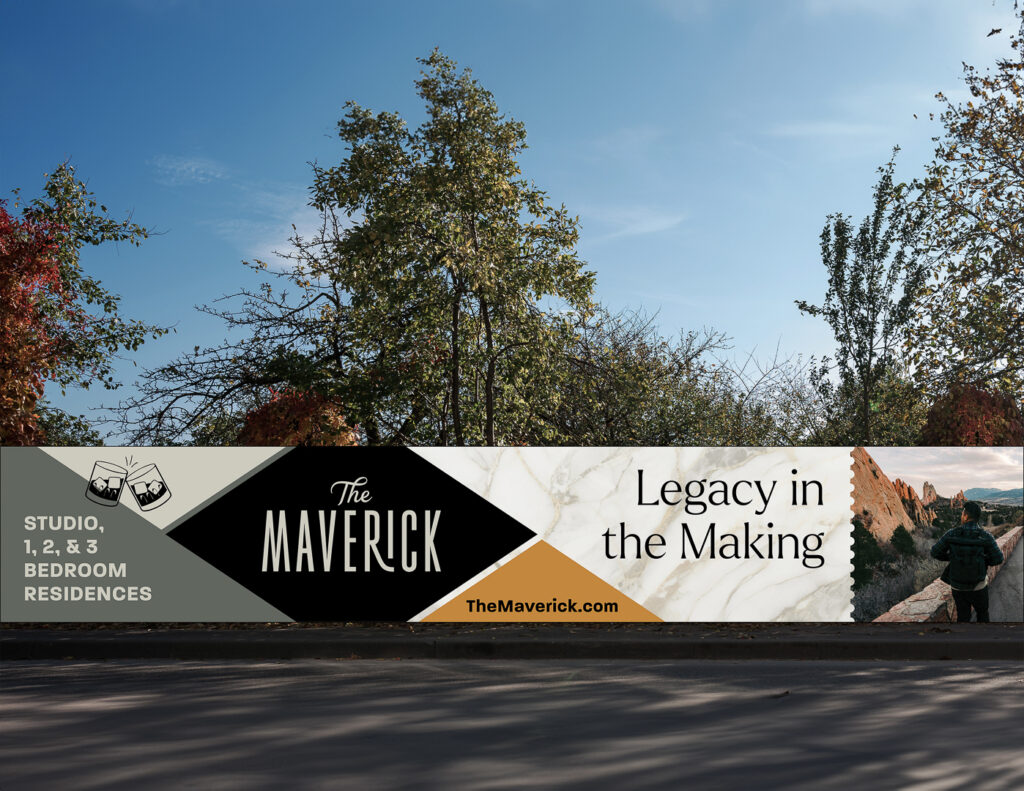
The tagline — Legacy in the Making — reframes ambition as something inheritable, which is exactly the move for a resident who’s renting on the way up. The positioning headline, Dream in Wide-Screen, plants the cinematic flag and recurs across every touchpoint. Copy across the brand sounds confident but not loud, witty but not jokey. The volume slider sits low on purpose. (The brand is amused by the shouting attention-seeking of its competitors. It just doesn’t feel the need to match it.)
When we describe the brand internally, the shorthand is: equally suited to Cary Grant or Beth Dutton. Old Hollywood elegance, but with enough edge to feel like it belongs in 2026.
The design toolkit follows the same logic. Marble texture. A diamond-shaped ornamental mark with Victorian-cigar-label energy. Whiskey glass and campfire line illustrations. None of it literal. All of it lived-in. The vibe of a curated Modern Glam clubhouse, expressed through visual artifacts instead of furniture.
The Bigger Lesson: When the Building Can’t Be the Differentiator
The most useful thing about The Maverick (for our multifamily marketer readers) isn’t the wordmark or the color palette. It’s the underlying logic.
Walk into any growing submarket right now and you’ll see the same pattern. Garden-style new construction. Comparable amenity packages. Similar finishes. Rents clustered within a couple hundred dollars of each other. Even the marketing photography is starting to look identical. The buildings have been competed down to near-equivalent.
So where do you actually compete?
The brand. Not because brand is more important than the building (it isn’t), but because everything else has been so thoroughly equalized that brand becomes the only meaningful lever. Maybe the only one. The properties that come out on top in saturated markets aren’t the ones with marginally nicer fitness centers. They’re the ones whose brand makes a renter feel something specific the second they land on the website. And this feeling can carry all the way through to lease signing.
The Maverick now occupies a spot in the Monument market that none of its direct competitors are claiming: a luxury apartment community that reads as a curated lifestyle property rather than a high-spec construction product. For our “Sam 4.0” who has the income to buy and is choosing to rent, that’s exactly the differentiator that makes the address worth signing for.
The brand makes a promise the building can keep: living at The Maverick isn’t a stopgap on the way to ownership. It’s an upgrade.
Thinking through brand strategy for an upcoming lease-up? Wondering whether your existing community brand is doing enough to actually differentiate? Let’s talk. Branding is what we do.
Lease a
